What If Your Language
Was Already Distributed?
Elixir & the BEAM
Demo
distributed music · phones as nodes · live state handoff

What just happened
No message broker.
No coordination service.
No glue code.
Distribution isn't a feature I added.
It's where Elixir starts.
The gravity well
Most apps are born single-node.
Scaling means escaping the gravity well:
- rip the assumptions out of code that assumed one machine
- bolt on a broker, a queue, a coordination service
- re-think state that was never meant to move
Expensive. Risky. Often a rewrite.
Elixir apps are born in orbit
The network, process coordination, supervision, message passing —
already there, whether you use them today or not.
You don't escape the gravity well. You were never in it.
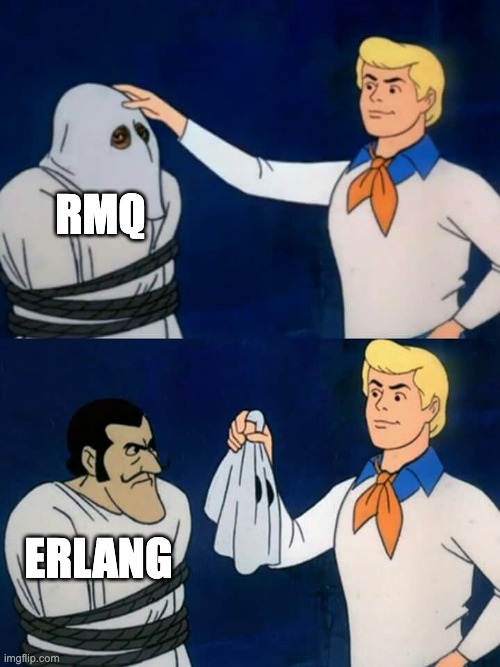
"I need distribution / concurrency"
It was Erlang all along.
Three projects.
Zero distribution code.
① The desk datacenter
A weekend project: scrape a large pile of documents —
the kind you may have heard about in the news —
and make them searchable.
Two machines, one cable
Storage on one. Compute on the other.
An ad-hoc datacenter on my desk.
How I "distributed" it
# Spread thousands of extraction workers across both machines.
# Horde decides which node each one lands on.
for email <- emails do
  Exstein.Distributed.HordeSupervisor.start_child(
    {Exstein.Distributed.EntityExtractor, email.id}
  )
end
I didn't write a networking layer.
I changed where processes run.
② Livebook
The pitch: replace Jupyter in your toolbelt.
What you actually get is more — because of distribution.
A notebook that reaches into a live system
- Connect the notebook to a running node
- Analyse real state and real data, in place
- No export, no CSV dump, no stale snapshot
Your analysis runs where the data already lives.
③ Mob
A framework that runs the BEAM inside iOS and Android apps.
Lots of distribution wins here. Start with a pedestrian one.
One pipeline for two platforms
- iOS and Android apps both talk to the dev server over BEAM distribution
- Not an HTTP bridge, not a websocket shim — the same wire the cluster uses
- A superior dev connection: RPC into the app, read its state, hot-load code
Demo
drive a running phone app from the laptop · introspect live state

The pattern
Side project. Analysis tool. Shipping product.
In none of them did I design for distribution.
It was already there when I reached for it.
"We have Kubernetes."
"We already have orchestration, self-healing, scaling, service discovery."
"So we don't need Elixir."
They look like competitors
Both do supervision · self-healing · distribution · scaling.
The overlap is real — and it's only at the surface.
They work at different granularities.
Different layers, same idea
Pod restart is a sledgehammer: kill the container, lose in-memory state, wait seconds.
Supervisor restart is a scalpel: one failed process restarts, millions keep running.
They fill each other's gaps
Proof they compose: libcluster's Kubernetes strategy —
BEAM nodes discover each other through the K8s API.
I ran them together
last job — placeholder for the concrete story
Kubernetes manages your machines.
Elixir manages what happens inside them.
You want both.
Scale 'later'?
- You start with distribution solved
- Scaling isn't a rewrite — your code was distributed from line one
- The industrial-grade version is already running
- …and it's Elixir, so it's pleasant to build with
The false choice
You've been conditioned to pick one:
easy to build | scales industrially
You can have both.
Thank you